
Percentage Profit & Loss: A Complete Guide with Pathyacram
“Your journey to a healthy lifestyle begins here.”
What is Percentage Profit & Loss?
Understanding Percentage Profit & Loss is a fundamental concept in mathematics and finance that helps individuals and businesses analyze transactions, maximize profits, and minimize losses. Mastering this concept is essential not only for competitive exams but also for real-life scenarios like trading, business planning, and investment decisions. At Pathyacram, we focus on building a strong foundation in such crucial concepts, ensuring students gain both theoretical knowledge and practical problem-solving skills.
Loss &Profit Percentage Formula
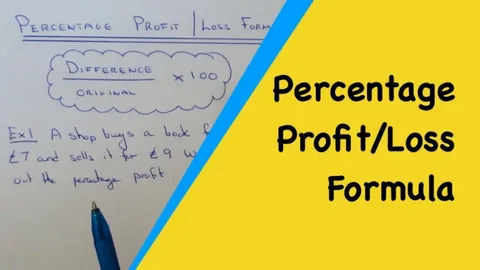
For example, if an item costs $500 and is sold for $600, the profit is $100. The profit percentage would be (100/500) × 100 = 20%. By practicing such calculations regularly, students can enhance their analytical skills and speed, which are vital for competitive exams.
Calculating Profit on Shares
Calculating profit on shares is an essential skill for investors and students alike, as it allows you to determine the effectiveness of your investment decisions. When you buy shares at a certain price and sell them at a higher price, the difference between the selling price and the purchase price represents your profit. The profit percentage helps you understand how well your investment has performed relative to the initial cost.
Using Geometry in Profit Calculations
For example, consider a company that needs to cover a rectangular floor with tiles. To calculate the total cost of tiles, you first need to determine the area of the floor using the formula: Area = Length × Width. If the cost of each tile is known, multiplying the area by the cost per unit gives the total expenditure. Selling the product or service at a higher price than this cost results in profit. Similarly, for a triangular or circular area, formulas like Area of Triangle = ½ × Base × Height or Area of Circle = π × Radius² are used to determine material requirements accurately, which helps in minimizing wastage and maximizing profit.
Practical Significance
At Pathyacram, students are trained to apply these concepts practically. By combining mathematical principles like height, distance, and trigonometry with financial calculations, students develop a deeper understanding of how abstract math translates into tangible results. This approach not only strengthens problem-solving skills but also builds analytical thinking, enabling students to approach profit and loss problems strategically and confidently in exams and real-life situations.
Using Geometry to Optimize Profit and Cost Calculations
While geometry may seem unrelated to financial calculations at first glance, it plays an important role in certain profit and loss scenarios, especially in fields like construction, shipping, and manufacturing. Geometric principles help in estimating costs, optimizing resources, and ensuring efficiency, all of which directly impact profit margins.
Shares and Dividends: Applying Profit & Loss Concepts
Dividend Yield Calculations
Understanding dividend yield Height And Distance involves percentage calculations to determine the effective income from investments. Pathyacram emphasizes solving real-life problems involving shares and dividends to strengthen students’ practical understanding of percentages.
Calculating Average Profit
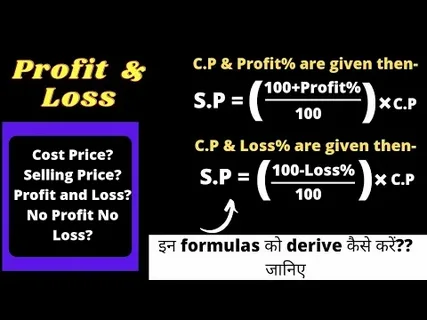
Calculating average profit is an essential technique to understand overall performance over multiple transactions. While individual profits or losses give a snapshot, the average helps in analyzing trends, identifying patterns, and making informed business decisions. This concept is widely used in finance, trading, and competitive exams, and mastering it ensures a strong foundation in Percentage Profit & Loss.



Square Root & Cube Root: Building Calculation Skills
Division for Backward Calculation
Finding the cost price from the selling price and profit percentage requires division. Mastery of these operations is emphasized in Pathyacram, enabling students to tackle complex numerical problems confidently.
Mastering these operations ensures that students can handle a wide range of numerical problems, including multi-step questions involving discounts, taxes, or successive profits and losses. Practicing such problems improves speed, accuracy, and confidence, which are essential for exams and real-life financial decision-making.
Using Multiplication and Division to Solve Profit & Loss Problems
At Pathyacram, students are trained with a variety of examples and exercises that combine Multiplication And Division with profit and loss concepts. This methodical practice develops strong analytical skills and equips learners to solve both simple and complex problems confidently. It also helps students understand the logical relationship between cost price, selling price, and profit/loss, rather than relying solely on memorized formulas.
Average: Understanding Trends in Profit & Loss
Understanding average profit is essential for analyzing overall performance across multiple transactions. While individual profits and losses provide snapshots of specific events, the average profit helps identify trends, evaluate efficiency, and make informed business decisions. This is particularly useful for traders, businesses, and students preparing for competitive exams that involve Percentage Profit & Loss.
The formula for calculating average profit is straightforward:
Average Profit = Total Profit ÷ Number of Transactions
For example, imagine a trader earns profits of $200, $350, and $150 from three different transactions. The total profit is:
200 + 350 + 150 = 700
Dividing by the number of transactions:
700 ÷ 3 = 233.33
This means the trader’s average profit per transaction is $233.33. Knowing this allows businesses to plan budgets effectively, predict future profits, and adjust strategies for better results.
Conclusion
Mastering Percentage Profit & Loss is not just about memorizing formulas; it’s about understanding concepts and applying them in various contexts. From shares and dividends to square roots, averages, and even the Pythagorean Theorem, each mathematical tool contributes to solving real-life profit and loss scenarios effectively. Pathyacram focuses on holistic learning, ensuring that students not only solve problems accurately but also develop critical thinking and analytical skills applicable in both exams and everyday life.
Frequently Asked Questions
Q1 What is percentage profit and how is it calculated?
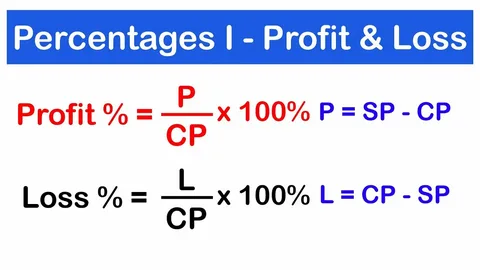
Ans Percentage profit is the gain earned on the cost price expressed as a percentage. It is calculated using the formula: Profit % = (Profit ÷ Cost Price) × 100. This helps in comparing profits across different transactions or products efficiently.
2. How can I calculate loss percentage?
Ans Loss percentage shows how much is lost relative to the cost price. It is calculated Loss % = (Loss ÷ Cost Price) × 100. This helps businesses and students understand where expenses exceed revenue and plan better strategies.
3. Can average profit help in business planning?
Ans Yes, calculating average profit over multiple transactions provides insight into overall performance. It helps identify trends, evaluate efficiency, and make informed decisions about pricing, investment, or resource allocation.
4. How do shares and dividends relate to profit and loss?
Ans Profit and loss concepts are directly applicable to shares and dividends. Buying shares at a lower price and selling at a higher price generates profit, while dividends provide additional income. Calculating percentages ensures informed investment decisions.